
Interacting safely with law enforcement
Authors: Jaleel Baker & Jacob Nyamu
This toolkit intends to serve as a resource for individuals and their families to feel prepared on how to safely engage with law enforcement when someone they know and love is experiencing a mental health crisis. Individuals with differences, such as autism, face an elevated risk of negative outcomes during police interactions. Black autistic youth are at especially high risk of experiencing negative outcomes during police interactions, as Black individuals have higher rates of police contact, use of force, and police-related mortality than other racial subgroups and across their lifetimes, Black males face a greater risk of being killed by police. Individuals with developmental disabilities, such as autism spectrum disorder, are 7 times more likely to come in contact with police than those without disabilities. We do not say this to scare you, but instead to help prepare you for the reality of how to interact with police during a mental health crisis if the situation ever presents itself.
Disclaimer:
Please only use this advice for educational purposes only. This is not formal legal advice, but simply educational tips based on common research and practices promoted by various civil rights organizations. We also do not intend for this document to encourage an over-reliance on law enforcement when working to de-escalate a familial or personal dispute that may rise to the level of a mental health crisis. Please utilize all resources available to you when trying to de-escalate a potential mental health crisis, and only involve law enforcement when you feel the situation has become potentially dangerous.
For parents/caregivers/family members:
Before Involving Law Enforcement:
According to the National Alliance on Mental Illness (NAMI), the first step in managing a mental health crisis is to assess the situation. Depending on the situation, you may be able to de-escalate by keeping your voice calm, asking how you can help, and listening to the other person’s concerns and requests. Consider employing familiar de-escalation tactics like asking, “Would it help if you had a moment alone?” or “Is there anything I can do to help you right now?” before considering reaching out to law enforcement, which oftentimes can be volatile.
If a person’s mental health crisis does not pose any immediate danger, you can reach out to someone who is familiar with that person’s health history. This might be a mental health provider (like a psychiatrist, therapist, nurse, social worker, or case manager) or a medical provider, like a primary care physician. This can also be a great first step before involving law enforcement.
On-Call:
When dealing with a mental health crisis and you feel police intervention may be necessary because someone may be a danger to themselves or others at this point, call 911 and immediately state it is a "mental health emergency.” Inquire if a Crisis Intervention Team (CIT) team can be sent, as they are usually staffed with mental health professionals who are trained to handle the situation. While waiting, provide the 911 operator with as much information as possible, including the person's mental health history and any relevant details, and stay as calm as you can.
On-Scene:
When law enforcement arrives to help de-escalate, the person who called should try to speak with the officers before the officers approach the person in crisis. You should remain calm and reiterate that “someone I love is experiencing a mental health crisis” and inform the officers that your loved one is on the spectrum. You can also say, “My loved one has a disability. Please be extra cautious with them.” You may want to inform the officers of any common triggers for your loved one as well, such as loud voices, or bright lights. Make sure to reiterate, “I am requesting a crisis intervention team or mental health professional to handle this situation.”
You may feel free to ask any officer to provide you their FULL NAME & BADGE NUMBER/ PATROL CAR NUMBER for your records before any interactions proceed further. Remember you have the right to remain silent and can respectfully choose to not answer questions at any time. You also have the right to record police interactions, and should quietly and safely remove yourself to the background of the situation and begin recording. As long as you stand at a safe distance, do not interfere with any ongoing officer activity, and do not stand close enough to obstruct their movements, you have the right to observe and record events that are plainly visible in public spaces.
After Police Interactions:
Please remember to write down any observations immediately after any police interactions, and to file a written complaint using the local law enforcement agency website if you feel your rights have been violated. You can also reach out to Disability Rights California’s intake line to speak with advocates who have experience representing individuals on the spectrum who have been affected by police violence.
If your loved one is placed on a medical hold, make sure to inform hospital staff that they have autism and may require heightened attention with sensory sensitivities, triggers, and require effective de-escalation strategies. Closely monitor staff for common risks, including misinterpretation of autistic behaviors, overmedication, or unnecessary restraints. Remember patients do not lose their rights by being hospitalized or receiving services, and have all rights accorded to a voluntarily admitted client. Make sure to track the 72-hour timeline, understand possible outcomes (release, voluntary admission, or extension to 14-day involuntary hold), and ensure that you establish consistent communication with the assigned patients’ rights advocate if an extension is proposed. After discharge, you can support your loved one by creating a crisis plan, identifying personal improvements, and thinking about how to quickly contact other law-enforcement alternatives.
Non-Emergency Resources:
You can also search the web ahead of time to see if your country or city has a mobile crisis response team. You can just search the web using the following keywords:
[City/County + Crisis Intervention Team/Mobile Crisis Response Team]
[Ex: Sacramento County Mobile Crisis Response Team]
A mobile crisis team is a group of mental health professionals who are responsible for responding to mental health emergencies that occur outside of a hospital or clinical setting. The goal is to connect people with immediate, on-site care that allows them to stay in their community and out of a hospital or police setting. You can save any helpful resources you find regarding your local crisis response team, such as phone numbers or service hours, to keep on hand in case of an emergency. You can also reach out to 988 to request a mental health crisis team, as they cover many areas in CA and can send mental health professionals without police or with police in a support-only role.
For autistic adults:
Preventative Measures:
To better prepare you for the unpredictable interaction with law enforcement, we recommend following common tips taught by prominent civil rights organizations and the following preventative measures;
Install smart automations on your phone.
If you have an iPhone, download this SIRI shortcut.
If you have an Android device, download MacroDroid.
These automations can be tweaked to your liking e.g., you can opt to have the video footage uploaded to an external cloud storage or turning down your display’s brightness. We recommend having the automation at the very least notify your loved ones, send them your location, and record your interaction with the law enforcement officer.
Using SIRI or Google Assistant, you can update the trigger words e.g. Popo, Feds, Cops, Five-Oh, that will run the automation much faster.
Give the automations a test to make sure it’s running as expected.
Print Kipekee’s safety card.
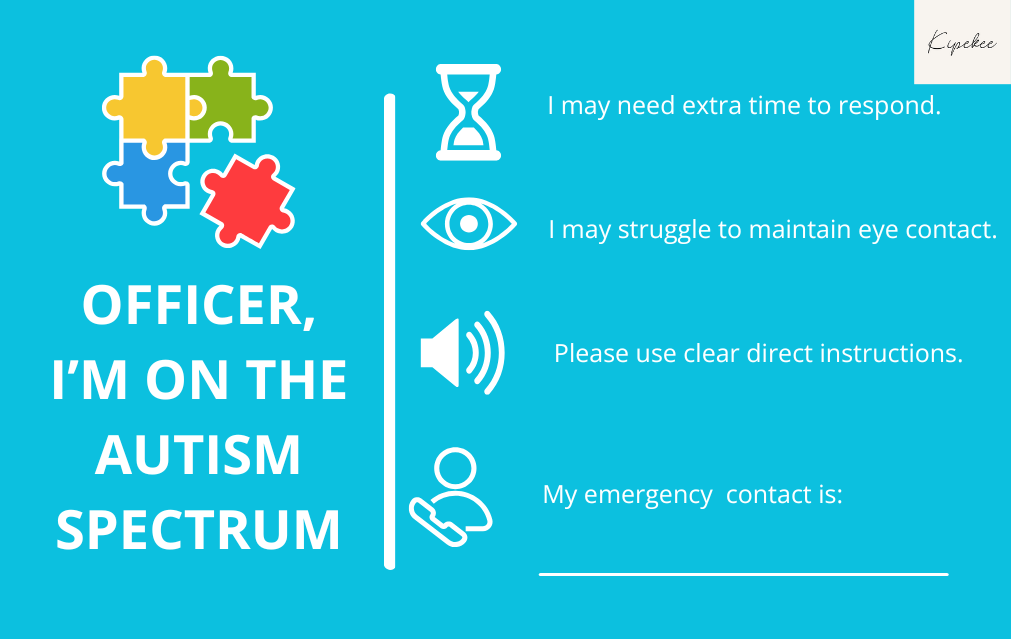
3. Buy an emergency medical wrist band.
Add your loved ones’ phone number.
Call to Action:
Pick up the phone. Call your local representatives. Ask for Crisis Intervention Teams and autism-informed police training. Here’s a phone script you could use;
“Hello, my name is [Your Name], and I’m a constituent from [City or ZIP Code].
I’m calling to urge [Representative/Council Member/Mayor] to support funding and implementation of Crisis Intervention Teams and mandatory autism-informed training for police officers.
Autistic adults are at higher risk during police encounters, often due to misunderstandings around communication, sensory sensitivities, and behavior under stress. Proper training and crisis response teams can prevent harm, de-escalate situations, and save lives.
I strongly believe our community deserves law enforcement that is prepared to interact safely and respectfully with neurodivergent residents.
Please let me know where [Representative’s Name] stands on this issue. Thank you for your time.”
If you prefer to email, feel free to use this draft;
Subject: Support Crisis Intervention Teams and Autism-Informed Police Training
Dear [Representative’s Name],
My name is [Your Name], and I am a constituent from [City or District]. I am writing to urge you to support funding for Crisis Intervention Teams and mandatory autism-informed training for law enforcement.
Autistic adults are at increased risk during police encounters due to differences in communication and sensory processing. Proper training and crisis response teams help officers de-escalate situations safely, prevent harm, and save lives.
This is a critical public safety issue, and I respectfully ask you to prioritize policies that protect autistic residents and promote safer community interactions. I would appreciate knowing your position on this matter.
Thank you for your time and service.
Sincerely,
[Your Name]
[City, State]
Autistic individuals have significantly influenced the world throughout history, the present and the future. Their perspectives drive innovation, challenge systems, and imagine solutions others overlook. Protecting and investing in autistic adults is not merely a charitable act; it’s essential, because when autistic minds are supported, society becomes stronger, wiser, and more humane.
This toolkit was made in honor and remembrance of Victor Perez (17 yo), Ryan Gainer (15 yo), Colin Jennings (26), Kayden Clark/Danielle Jacobs (24 yo), Eric parsa (16 yo) and countless others who weren’t diagnosed or reported.
